Pre-Seed vs Seed Funding: What’s actually different in 2026

If you’re a first-time founder figuring out fundraising, the line between pre-seed and seed can feel blurry. Both stages involve raising money early. Both involve pitching investors. And the terminology has shifted so much over the past five years that even experienced founders sometimes use the terms interchangeably.
But pre-seed and seed are meaningfully different stages in 2026, and confusing them can lead to targeting the wrong investors, setting the wrong valuation expectations, or raising at the wrong time. This guide breaks down the real differences using current data, including insights from the Carta 2026 Founder Ownership Report and patterns we see across the thousands of raises tracked on Capwave.
About Capwave: We’re the fundraising intelligence platform behind 89,000+ tracked investors and over $1B in collective raises facilitated. The benchmarks in this post come from real fundraising processes, not theory.
What Is Pre-Seed Funding?
Pre-seed is the earliest institutional or semi-institutional fundraising stage. At pre-seed, you’re typically raising capital to go from idea or early prototype to a working product with initial traction.
The typical pre-seed round in 2026 ranges from $250K to $1.5M. According to Carta’s data, the median pre-seed round size has grown roughly 30% since 2021, reflecting both inflation in startup costs and increased investor appetite for earlier-stage bets. Most pre-seed rounds are priced between a $3M and $10M pre-money valuation, with the median sitting around $6M for US-based startups.
Pre-seed investors include angel investors, pre-seed focused micro-funds (typically under $50M in fund size), accelerators like Y Combinator and Techstars, and sometimes friends and family putting in structured capital. The check sizes at pre-seed typically range from $25K to $250K per investor.
At this stage, investors are primarily betting on the founding team and the problem they’re solving. They expect to see a clear thesis about why this problem matters, evidence that the founders understand the space deeply, and some signal of early validation, even if that signal is a waitlist, a handful of design partners, or strong qualitative customer discovery.
What Is Seed Funding?
Seed funding is the next stage up. At seed, you’ve typically built a product that works, and you have some form of traction that demonstrates market pull. The seed round funds your push from early traction to repeatable growth.
The typical seed round in 2026 ranges from $1.5M to $5M, with the median around $3.5M according to recent PitchBook and Carta data. Seed valuations in 2026 generally fall between $8M and $25M pre-money, depending on sector, traction, and geography. The median seed pre-money valuation sits around $14M for US startups.
Seed investors include dedicated seed funds (often $50M to $200M in fund size), multi-stage firms writing early checks, and occasionally super-angels writing $500K or more. Check sizes at seed typically range from $250K to $2M per investor.
At the seed stage, investors are looking for product-market fit signals. That doesn’t mean you need perfect PMF. It means they want to see real users or customers engaging with a real product, some measurable retention or revenue, and a credible path to scaling what’s working. The bar has risen since 2023. Seed investors in 2026 increasingly expect to see $10K to $50K in monthly recurring revenue (or equivalent engagement metrics for non-SaaS businesses) before committing.
The Five Real Differences Between Pre-Seed and Seed
1. What You’re Proving
At pre-seed, you’re proving the problem is real and you’re the right team to solve it. Investors are backing your insight, your domain expertise, and your early hypothesis. A demo or prototype helps, but it’s not strictly required.
At seed, you’re proving the solution works and people want it. The conversation shifts from “Is this a good idea?” to “Is this gaining traction?” Investors want to see evidence that your product solves the problem in a way customers value enough to use repeatedly, or pay for.
This distinction matters because it changes how you pitch. A pre-seed pitch should be heavily weighted toward the problem, the market, and the founding team. A seed pitch should lead with traction, metrics, and what you’ve learned from real users.
2. Round Size and Valuation
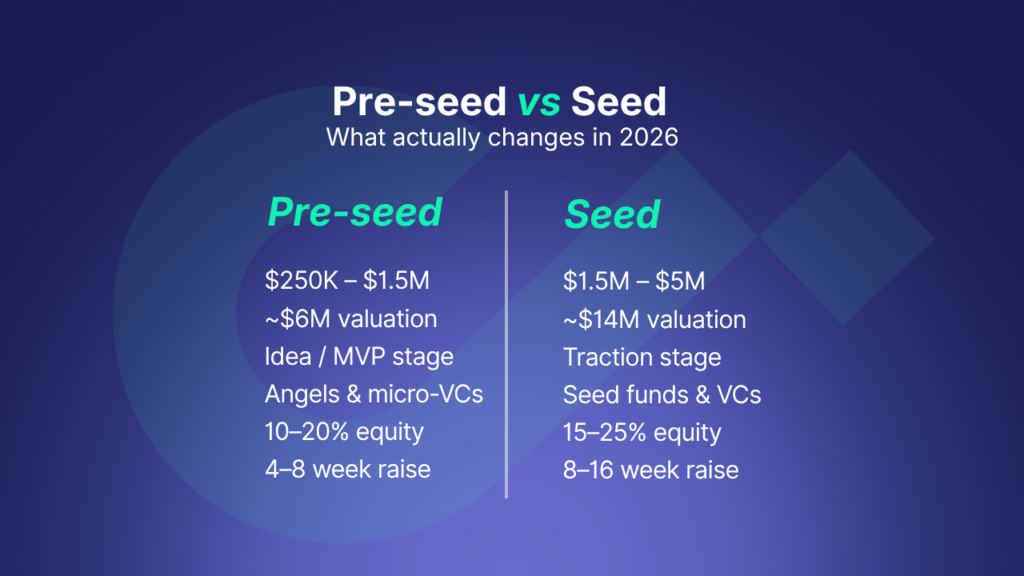
The numbers have shifted significantly since the peak of 2021. Here’s where things stand in 2026:
Pre-seed: $250K to $1.5M raised at a $3M to $10M pre-money valuation (median: ~$6M).
Seed: $1.5M to $5M raised at an $8M to $25M pre-money valuation (median: ~$14M).
These ranges vary by sector. AI and deep tech startups often command higher valuations at both stages due to investor demand in those categories. According to PitchBook’s Q4 2025 data, AI-focused seed rounds closed at a 20% to 30% premium over the median across all sectors.
One important note: setting your valuation too high at pre-seed makes your seed round harder. If you raise at a $10M pre-seed valuation, you need to show significant progress to justify the step-up investors expect at seed (typically 2x to 3x). Across the raises we track at Capwave, founders who price their pre-seed conservatively tend to have smoother seed raises 12 to 18 months later.
3. Who Invests
The investor landscape is different at each stage, and this is where many founders waste time by targeting the wrong people.
Pre-seed investors typically include: angel investors and angel syndicates, micro-VCs with fund sizes under $50M, accelerators (YC deploys $500K, Techstars offers up to $120K), and occasionally institutional seed funds writing smaller “scout” or “discovery” checks.
Seed investors typically include: dedicated seed-stage VC funds, multi-stage venture firms making early bets, corporate venture arms with strategic interest in your sector, and family offices increasingly active at seed stage.
There is overlap, and some firms invest at both stages. But if you’re pre-seed, pitching a fund that only writes $1M+ seed checks will waste your time and theirs. Capwave tracks check sizes and stage preferences across 89,000+ investors, which helps founders filter for the right fit before they start outreach.
4. How Much Equity You Give Up
The Carta 2026 Founder Ownership Report provides the clearest picture of dilution at each stage. At pre-seed, founders typically give up 10% to 20% equity, with the median at approximately 15%. At seed, the range is 15% to 25%, with the median around 20%.
These numbers matter for your long-term ownership. If you give up 18% at pre-seed and 22% at seed, you’ve diluted roughly 36% before your Series A even starts. That’s before the Series A itself (typically 20% to 25% dilution) and any option pool expansion.
Founders who plan their cap table across multiple rounds tend to make better decisions at each stage. The general guideline: aim to retain at least 50% ownership through your seed round. If pre-seed dilution is pushing you below that trajectory, either raise less capital or negotiate a higher valuation, and be prepared to justify it with traction.
5. Timeline and Process
Pre-seed fundraising typically takes 4 to 8 weeks once you’re actively pitching. The process is less formal. Many pre-seed rounds close on SAFEs (Simple Agreements for Future Equity) rather than priced equity rounds, which reduces legal costs and negotiation time. Decision cycles are faster because check sizes are smaller and individual investors or small fund GPs can move quickly.
Seed fundraising takes longer, typically 8 to 16 weeks. More investors means more diligence. Seed rounds are increasingly priced rounds (especially above $2M), which involves term sheet negotiation, legal documentation, and sometimes board seat discussions. Multi-stage firms that write seed checks often have investment committee processes that add 2 to 4 weeks to their decision timeline.
We covered the week-by-week breakdown of what a pre-seed raise actually looks like in our pre-seed fundraising timeline guide on the Capwave blog.
How to Decide Which Stage You’re At
If you’re unsure whether you should be raising a pre-seed or seed round, ask yourself these three questions:
Do you have a product in the hands of real users? If yes, and those users are showing engagement or willingness to pay, you’re likely at seed stage. If no, or if you’re still in early testing with a handful of design partners, you’re pre-seed.
Can you point to a specific growth metric? Seed investors want at least one metric that’s trending in the right direction: MRR, weekly active users, retention rate, or pipeline value. If your strongest data point is qualitative (“customers love it”) rather than quantitative, you’re likely still at pre-seed.
How much capital do you need for the next 12 to 18 months? If you need less than $1.5M to reach your next major milestone, a pre-seed round is probably the right structure. If you need $2M or more, you’re in seed territory.
If you’re right on the boundary, consider this: it’s better to raise a strong pre-seed with clear milestone targets than to stretch for a seed round before you have the traction to justify it. Seed investors who pass on an underbaked seed pitch are harder to re-engage than pre-seed investors who see you executing on a clear plan.
The Pre-Seed to Seed Bridge: What Investors Want to See
One of the most common questions we hear from founders on Capwave is: “What do I need to show to go from pre-seed to seed?” The honest answer is that every investor’s bar is slightly different. But across the raises we track, here are the most common milestones that unlock a seed round:
For SaaS companies: $5K to $50K MRR, 3 to 6 months of retention data showing low churn, and a clear acquisition channel that’s working.
For marketplace or consumer companies: 1,000 to 10,000 active users, evidence of organic growth (not just paid), and unit economics that suggest a viable business model.
For deep tech or hardware companies: A working prototype with pilot customer validation, at least one LOI or paid pilot, and a defensible technical advantage.
For AI companies (the fastest-growing category in 2026): A working product with measurable accuracy or performance improvements over alternatives, evidence of customer willingness to pay, and clarity on data moats or technical defensibility.
The thread connecting all of these: investors want to see that you’ve learned something from the pre-seed capital that reduces risk for the seed round.
Frequently asked questions
What is the difference between pre-seed and seed funding?
Pre-seed funding is the earliest institutional fundraising stage, typically $250K to $1.5M raised to go from idea or prototype to a working product. Seed funding is the next stage, typically $1.5M to $5M raised to scale a product that already has initial traction. The main difference is what you’re proving: pre-seed proves the problem is real and the team is right, while seed proves the solution works and customers want it.
How much do pre-seed rounds raise in 2026?
The typical pre-seed round in 2026 ranges from $250K to $1.5M, with a median around $750K. Pre-money valuations at pre-seed typically fall between $3M and $10M, with the US median around $6M. These numbers have grown roughly 30% since 2021, according to Carta data.
What is a typical seed round size in 2026?
The median seed round in 2026 is approximately $3.5M, with most seed rounds falling between $1.5M and $5M. Seed-stage pre-money valuations range from $8M to $25M, with the US median around $14M. AI-focused seed rounds close at a 20% to 30% premium over the median, based on PitchBook Q4 2025 data.
How much equity should I give up at pre-seed?
Most founders give up 10% to 20% equity at pre-seed, with the median at approximately 15% according to the Carta 2026 Founder Ownership Report. Aim to retain at least 50% ownership through your seed round, which means keeping pre-seed dilution closer to 10% to 15% if possible.
Do I need revenue to raise a seed round?
Not always, but it’s increasingly expected. In 2026, most seed investors want to see at least $5K to $50K in monthly recurring revenue for SaaS companies, or equivalent traction metrics for non-SaaS businesses. Some deep tech and biotech seed rounds still close pre-revenue, but those founders typically compensate with strong pilot agreements, LOIs, or defensible IP.
What valuation should I set for a pre-seed round?
For US-based startups in 2026, the median pre-seed valuation is around $6M pre-money. Pricing too high at pre-seed makes your seed round harder because investors expect a 2x to 3x valuation step-up between rounds. If you don’t show enough progress to justify that increase, your seed raise will stall.
When should I raise a seed round instead of a pre-seed?
Raise a seed round when you have a working product with measurable traction, need $1.5M or more in capital, and can point to at least one quantitative growth metric trending in the right direction. If you’re still building your MVP or testing your first hypothesis, a pre-seed round is the better fit.
What’s the timeline for raising a pre-seed vs seed round?
Pre-seed rounds typically close in 4 to 8 weeks once active pitching begins. Most pre-seed rounds use SAFEs, which speed up the process. Seed rounds take longer, usually 8 to 16 weeks, because they involve more investors, more diligence, and increasingly priced equity structures.
Figuring out your fundraising strategy? Capwave tracks 89,000+ investors with real-time data on stage preferences, check sizes, and deployment activity. Whether you’re raising pre-seed or seed, find the right investors at capwave.ai.